Current photographic evidence
A volume appears in the public census only after a present, copy-specific photograph establishes that it survives and is the 1859 second edition. A catalogue record alone is not enough.
A Bibliographical Census
Second Edition · 1859
“Report of the Committee Appointed by the Philomathean Society of the University of Pennsylvania to Translate the Inscription on the Rosetta Stone” — second edition (1859)
This census follows the physical books: their original bindings, inscriptions, bookplates, repairs, and documented movement from one owner to the next.
Seventy-one documented surviving copies. Fifty-two retain original publisher’s cloth, seventeen have been rebound, and two have unrecorded bindings.
The 1859 census uses the same reading architecture as the 1858 census while keeping every conclusion tied to copy-specific evidence.
A volume appears in the public census only after a present, copy-specific photograph establishes that it survives and is the 1859 second edition. A catalogue record alone is not enough.
One physical volume receives one permanent S-number. Sales, transfers, repairs, and new photographs update that record rather than create duplicates.
Unidentified owners and gaps in provenance are recorded as unknown.
Fifty-two copies retain documented original publisher’s cloth bindings, each assigned one of six color variants. Decoration subtypes within Brown, Red, Blue, and Black are identified separately. Seventeen copies are rebound; two bindings are unrecorded.
A priestly decree issued at Memphis in 196 BCE, repeated in Hieroglyphic, Demotic, and Greek.
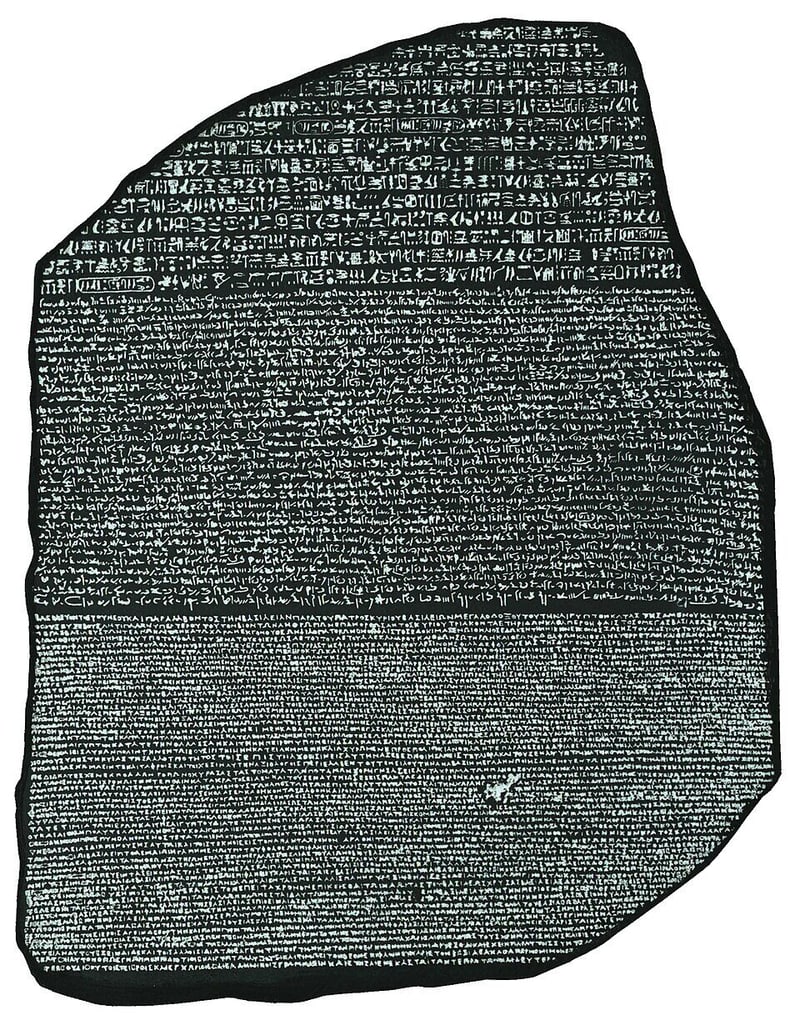
The Stone records royal benefactions, religious honors, and an order that the decree be displayed in temples in sacred, native, and Greek writing. The parallel texts supplied crucial points of comparison for the recovery of the Egyptian scripts.
Chromolithography, Egyptian figures, borders, inscriptions, and typography make the physical design part of the publication’s argument.
The Society’s committee brought the complete English translation and its explanatory apparatus back into print in 1859.
Successive colors were printed from separate prepared stones and aligned to form the elaborate title and dedication leaves.
The census records how those decorated leaves, bindings, and inserted materials survive differently in each copy.
Both illuminated title pages are undated. The 1859 printing is distinguished by an edition statement along the wooden base—documented in both red block capitals and a faint cursive form—together with a redesigned dedication leaf, publisher’s cloth bindings, and the appended Philomathean membership catalogue.
Undated. The illuminated title page carries no year and no edition statement of any kind.
Also undated, but the 1859 title adds an edition statement along the wooden base beneath the curtain. At least two lettering forms are documented: red block capitals in other examined copies and a faint cursive “Second Edition” in S008.
The census records this as a title-page lettering variant. The present evidence does not establish whether it represents a separate printing state, sequence, or issue.
A color-lithographed preliminary leaf dedicating the volume to the Hon. Henry D. Gilpin in a vivid botanical design.
The Gilpin dedication was carried into the second printing but completely redesigned in a darker, Egyptianizing style. Palm trees, a sphinx, and a standing figure replace the first edition’s botanical ornament.
The first edition was issued in decorated, smooth paper-covered boards with the sphinx-and-medallion design printed in metallic ink.
The six original publisher’s binding variants are executed in publisher’s cloth over boards. The census separately records decoration subtypes: Brown — Gilt Decoration and Brown — Green Decoration; Red — Gilt Sphinx Only and Red — Green Decoration; standard Black and Black — Extra-Gilt. Later repairs or bindings are recorded separately whenever identifiable original publisher’s cloth survives.
The 1858 first edition ends with the report itself. It does not include this separately titled Philomathean Society catalogue or the accompanying 1859 copyright notice.
The second printing appends the separately titled, 24-page “Catalogue of Members of the Philomathean Society, Instituted in the University of Pennsylvania, MDCCCXIII,” printed by Ringwalt & Co. and dated 1859 on its own title page.
A copyright notice slip—“Entered, according to Act of Congress, in the year 1859, by C. R. Hale, S. H. Jones, and H. Morton”—is tipped in among these pages. Neither the membership catalogue nor the notice appears in the 1858 first edition.
S006 combines three original translucent leaves with a smaller overall size, extraordinary gilt decoration, and gilt on every page edge. These features deserve examination together.
Its original black cloth carries elaborate gilt on both boards and the spine, with a gilt sphinx inside an ornamental oval on each board. The head, tail, and fore-edge are all gilt. This is the most extensively gilt-decorated binding currently documented in the census; S019 supplies the comparison with standard black publisher’s cloth.
Direct examination records the finished volume as approximately 3/16 inch smaller in both height and width than the standard copies compared with it. Three extremely thin original translucent leaves extend into the binding at the spine. The two illustrated above show the leaf at the chromolithographic title and the leaf beside the serpent illustration, between pages 136 and 137.
The copy is in poor condition, but this combination of surviving features remains distinctive. Its decorated, manuscript-style preface is part of the printed report. The full record discusses the differences separately and preserves all thirteen evidence photographs.
A quick visual survey of the 1859 records with public photographs. Open any entry to return to its complete census record, evidence, people, and public image gallery where available.
Presentations, bookplates, inscriptions, auctions, bequests, and institutional transfers connect individual books to the people who carried them forward.
A gift inscription dated January 1, 1867 precedes the volume’s documented 1911 accession from Baker’s estate into the Pocumtuck Valley Memorial Association Library. The repository identifies her as the earlier recipient; Ella and the second giver remain unidentified.
A Christmas 1863 inscription records a gift between two men in the Great Lakes railroad network.
Cooke’s 1883 estate catalogue records the book as lot 3167; the Athenæum acquired it at the sale.
The Academy bookplate documents a Philomathean alumnus’s gift to an American institution in Rome.
The copy moves from Charles R. Hale’s 1859 presentation through Mary Lavinia Avery and Samuel Putnam Avery into its Teachers College setting.
Balken’s presentation bookplate documents the transfer while the retained original red cloth preserves the binding evidence.
New photographs, repairs, sales, and transfers update one permanent S-number. Unresolved links remain visibly qualified.
Profiles of the authors, makers, presenters, recipients, and owners documented in the surviving copies. Charles Reuben Hale, Henry Morton, and Max Rosenthal appear first; within each group the remaining names are alphabetized by surname.
Only securely identified historical likenesses with traceable sources are included. Documentary images such as inscriptions and bookplates remain with their copy records.
21 verified portraits
One of the three Philomathean student authors of the 1858 Report. Hale translated the Greek and Demotic texts and became the central figure in the surviving authorial presentation network, with documented gifts to Washington Irving, Mary Jane Hale Welles, Archibald Campbell Tait, his uncle Elias White Hale, Caroline Amelia Hale Morgan, his parents Reuben Charles Hale and Sarah Jane Mills Hale, and—through S017 of the 1859 census—Miss Cordelia Hale. S042 preserves his presentation to Mrs. Blake at Newport, Rhode Island, on April 5, 1864. S028 adds a separate late-life association: a historical University of California accession label records the volume as a gift of the Right Rev. C. R. Hale, Bishop Coadjutor of Illinois. The label does not prove whether Hale donated S028 personally or whether it reached the institution through his estate. C060's paired parental inscriptions are the first in the current census where he writes “Charles” in full rather than “Chas.” After Penn he entered the Episcopal ministry. At the Civil War-era Naval Academy in Newport, Rhode Island, he served as deputy chaplain under command chaplain Mason Noble and as acting assistant professor of mathematics from July 1863 to January 1865. Naval Academy records include a June 10, 1864 order assigning Hale to the practice ship USS Macedonian and an October 7, 1864 letter detaching him to resume his academy duties. He later pursued liturgical and Eastern Christian scholarship and became coadjutor bishop of Springfield in 1892. His later career explains the literary, naval, ecclesiastical, and scholarly circles through which several copies circulated.
Morton carried out the Report’s hieroglyphic work and helped design its illustrations and decorative borders. He later became a prominent lecturer in physics and chemistry, chaired chemistry at the University of Pennsylvania, and served from 1870 until his death as the first president of Stevens Institute of Technology. Morton later served as vice president of the American Society of Mechanical Engineers. Morton’s 1892 firsthand recollection of the Rosetta project remains the principal account of its origins, collaboration, illustrations, and difficult chromolithographic production.
C063 adds a newly documented Morton-family circulation route: Alexander Hamilton “Hamilton” Morton, who presented the volume in New York in 1860, was the brother of Henry's father, the Rev. Henry Jackson Morton, and therefore Henry Morton's paternal uncle. The inscription date—December 11, 1860—was Henry's twenty-fourth birthday, though the reason for that date remains unproved.
A Polish-born American artist who studied lithography, drawing, and painting before settling in Philadelphia. Penn’s catalog credits Max Rosenthal and Henry Morton with the Report’s decorative borders, while Louis N. Rosenthal’s establishment printed the volume. Max later became known for portraits, etchings, and ambitious lithographic work and was active in Philadelphia’s artistic community. Separating the brothers clarifies artistic design from shop production.
Born in Philadelphia on 13 June 1837, the son of the Hon. Joel Jones (1795–1860) and Eliza Perkins Sparhawk. Joel Jones was a Yale-educated lawyer, judge of the Philadelphia District Court, the first president of Girard College (1847–1849), and Mayor of Philadelphia (1849–1851), as well as a biblical scholar and prominent civic figure. Samuel entered the University of Pennsylvania in 1853, earned an A.M., and completed an LL.B. in 1861.
One of the three Philomathean student authors and writer of the Report’s historical introduction. As Moderator of the Philomathean Society and a member of the Rosetta Stone Committee, Jones framed the translation within the discovery of the Stone and the history of decipherment, complementing Hale’s language work and Morton’s hieroglyphic and visual work. He went on to practice law in Philadelphia. On January 10, 1859, he personally presented C037 to Philadelphia publisher George William Childs. The surviving signed letter makes that volume a documented authorial presentation rather than a later association. The existence of an authorial presentation copy signed by Jones alongside Hale and Morton situates him within a well-established Philadelphia legal and civic family, in contrast to his previously thin documentation among the Report’s three authors.
A Polish-born lithographer whose Philadelphia establishment printed the Report. Contemporary cataloging and surviving imprints distinguish Louis’s production role from the artistic contribution of his younger brother Max Rosenthal. Henry Morton’s firsthand account describes repeated color presswork and close collaboration with the lithographic shop. Later Chicago records identify Louis as a paper dealer at 163 LaSalle Street. An obituary reports that he died in Chicago on January 20, 1902, in his seventy-eighth year, after living on Vincennes Avenue, and was buried at Waldheim Cemetery.
The gift inscription in S070 names Susan R. Barton as Joanna Rotch’s aunt. Susan was first married to Thomas Rotch and subsequently to Philadelphia surgeon John Rhea Barton. Her bequest established Penn’s John Rhea Barton Professorship of Surgery in 1877, the first endowed chair in surgery in the United States. The family relationship is corroborated by Joanna’s 1907 note preserved at the New Bedford Whaling Museum.
Gertrude Whittier Cartland was a principal of the Friends School in Providence alongside her husband Joseph. A cousin and close companion of John Greenleaf Whittier, she hosted the poet at the couple’s Newburyport home. The S068 inscription names both Cartlands as recipients of their pupil Hannah B. Longstreth’s October 1859 gift.
Joseph Cartland and his wife Gertrude were principals of the Friends School in Providence, Rhode Island. Both were cousins and close companions of the poet John Greenleaf Whittier, who stayed at their Newburyport home late in his life. S068 was presented to the couple by Hannah B. Longstreth, who described herself as their pupil, in October 1859.
S030 records Henry Morton’s presentation of the volume to Emma Lewis. She was the Philadelphia author Emma Lewis, born May 9, 1827, the daughter of Ellis Lewis of the Philadelphia bar and Hester Griffitts, daughter of Dr. Samuel Powel Griffitts. Her father was the son of the merchant David Lewis and is not to be confused with Ellis Lewis, Chief Justice of Pennsylvania. Her book Treasures of Darkness (1854) is dedicated to Henry Morton’s father, the Rev. Henry J. Morton, D.D., rector of St. James’ Church, Philadelphia, “whose pastoral care during years of weary confinement, has lightened the sufferings of sickness.” That tie to the Morton household supports the identification of the recipient.
Robert C. Moon’s The Morris Family of Philadelphia, vol. II (1898), gives her dates and parents on p. 757 and her father’s standing at the Philadelphia bar on p. 759. It records that, although an invalid for thirty-five years, she devoted herself to good works and literary pursuits, and that in May 1874 she was one of the four founders of the Morris Refuge Association for Homeless and Suffering Animals in Philadelphia. She published as “E. L.”: Night Watches; or, The Peace of the Cross (Philadelphia: W. P. Hazard, 1853) and Treasures of Darkness (Philadelphia: Willis P. Hazard, 1854), devotional verse whose title page names its author as “authoress of ‘Night Watches.’” Cushing’s Initials and Pseudonyms attributes the books to her. She died on March 13, 1883.
The Thomas Fisher Rare Book Library purchased the volume in May 1976 from a bookseller recorded as “Thompson”; ownership between Emma Lewis and that sale is unrecorded.
Hannah B. Longstreth presented S068 to Joseph and Gertrude Cartland in October 1859, identifying herself as their pupil. Her name and relationship to the recipients are established by the manuscript inscription. Her life dates and wider biographical identity are unestablished.
Joanna Rotch received S070 from her “affectionate Aunt” Susan R. Barton in Philadelphia on May 23, 1859. A 1907 note by Joanna preserved at the New Bedford Whaling Museum independently names “Uncle Thomas Rotch and Aunt Susan Barton,” corroborating the family relationship. Her commonplace book of 1839–1866 survives in the Massachusetts Historical Society’s Lamb Family Papers.
The S067 bookplate names William D. Stuart beneath a winged crest and the motto “NE CEDE MALIS.” A separate Stuart signature is dated “Jan. 1875”; its initials are indistinct, and the relationship between the two marks is unrecorded. The bookplate does not establish Stuart’s dates or occupation.
The William L. Clements Library acquired S049 in 1945 as a gift from Randolph G. Adams, its first director. Born in Philadelphia, Adams graduated from the University of Pennsylvania in 1914, where he was moderator of the Philomathean Society, the society whose members prepared the Report. He directed the Clements Library at the University of Michigan from 1923 until his death in 1951 and also held a professorship of history there.
An earlier ownership inscription in S049 records Alice G. Bryant. How the volume passed from Bryant to Adams is unrecorded.
S017 bears the Ellen Walters Avery memorial bookplate. Ellen Walters Avery (January 1, 1861 – March 25, 1893) was the youngest daughter of Samuel Putnam Avery and Mary Ogden Avery. In 1897 her parents gave her books to Teachers College in her memory, forming the Ellen Walters Avery Collection, and the bookplate commemorates that gift. Its application to this volume is undated.
S017 records that Cordelia Hale's copy was later bequeathed to Mary Lavinia Avery. A note dated February 14, 1904, states that Avery had died the preceding month and identifies her as the librarian in charge of the Drexel Musical Library at the Lenox Branch of the New York Public Library. The note also records her bequest of the volume to Samuel P. Avery, expressly adding that they were not related.
Vassar College identifies Mary Lavinia Avery (1848–1904) as a pioneering librarian who organized the Pratt Institute Free Library and later classified and catalogued the Drexel Musical Library at the New York Public Library. That institutional biography, the May 1898 Vassar Miscellany notice, and the copy evidence establish the same woman rather than relying on the surname alone.
The New York Library Club’s account places Avery and Charles D. Gillis at the same Lenox meeting on November 10, 1898. Gillis, the leading candidate for S002’s recipient, discussed the genealogy and local-history collection; Avery discussed the Drexel music collection. This documents a shared event, not an exchange of the two census books.
The February 14, 1904 note in S017 says that Mary Lavinia Avery left the book to “Mr. Samuel P. Avery,” although the two were not related, and is signed “S. P. A.” Teachers College records identify Samuel Putnam Avery as the collector and benefactor who, with his wife Mary Ogden Avery, established the Ellen Walters Avery Collection in memory of their daughter.
S017 bears the Ellen Walters Avery memorial bookplate and is now at Teachers College. That combination makes Samuel Putnam Avery the documented 1904 recipient and strongly suggests a later Avery transfer to Teachers College, but the exact donation date for this volume is unrecorded.
The PVMA donation label names “C. Alice Baker / of Boston & Deerfield.” The repository identifies her as Charlotte Alice Baker and as the recipient of the gift dated January 1, 1867. The label names Baker; PVMA’s accession records confirm that her estate transferred the volume in 1911. The earlier inscription addresses an unnamed friend.
Baker established schools with Susan Minot Lane and pursued historical research in New England and Canada. Her True Stories of New England Captives Carried to Canada During the Old French and Indian Wars appeared in 1897. She also restored Deerfield’s Frary House. These activities place the book in the personal library of a working educator and historian, though they do not establish why her friends chose it.
Ella and a second giver represented by an unclear quoted character remain unidentified. Emma Lewis Coleman, Baker’s later collaborator and biographer, preserved original letters in her 1933 biographical study.
The presentation bookplate on S024 reads “Carnegie Institute of Technology / Hunt Library / Presented by Edward Duff Balken.” It directly identifies Balken as the donor and places the volume within his collection before its institutional transfer.
Balken was a Pittsburgh collector and museum figure whose collecting of American provincial art has been documented by Princeton University’s Art Museum. A published 1938 portrait securely identifies him. The exact date and earlier route by which he acquired S024 remain open questions.
The inscription names Maria Banks as the “sincere friend” who gave the book to the Rev. George Potts, D.D. The gift is dated June 2, 1860.
Two candidates have distinct documentary trails. Maria Bonney Fleet married Edward M. Banks on October 19, 1859 and could have used this surname in June 1860. Another Maria was the daughter of William Banks and Isabella Henderson Lenox Banks. Her letters of 1861–1865 survive in the Albany Institute’s Banks Family Papers, DM 580, Box 1, Folder 10. Neither woman is established as the presenter.
An 1856 Fifth Avenue Presbyterian membership entry names Maria Banks without identifying her parents. Maria Hawxhurst Banks, widow of Daniel Banks and a Westbury Quaker, is a further contemporary namesake. The people and the distinct Presbyterian congregations must not be merged.
The University of Chicago’s donor notation names “Miss E. M. Banvard.” A 1936 Minnesota History article identifies John Banvard’s daughter as Edith M. Banvard of Chicago and documents her stewardship of her father’s archive. The uncommon exact initials, city, and archival association strongly support the identification.
“Miss E. M. Banvard” appears on the donor bookplate and a corresponding pencil gift notation on the title-page verso. The expanded identification as Edith M. Banvard remains strongly supported; neither the full name nor the date of the gift is established by these photographs alone.
Aaron W. Berg’s bequest bookplate in S012 records the gift to Columbia following his death in 1978. A lawyer, Berg graduated from Columbia College in 1924 and Columbia Law School in 1927. He served as vice-president and president of the Alumni Association of Columbia College (1954–1958) and on the board of directors of the Alumni Federation of Columbia University (1946–1958). His papers are at Columbia’s Rare Book & Manuscript Library. Earlier ownership of S012 is unrecorded.
S061 names Commodore George S. Blake as its donor to AAS on February 26, 1864. His signed letter survives tipped into the volume. Blake directed the U.S. Naval Academy during its Civil War relocation to Newport, Rhode Island, where Charles R. Hale served as a chaplain and taught mathematics.
Blake also sent AAS drawings of Dighton Rock in 1864, prepared by Edward Seager with Hale’s assistance, and Hale’s related essay in 1865. The inscription in S042 clearly names Mrs. M. A. A. Blake, probably Blake’s wife, Mary Ann Allen Barron Blake. The two books document separate gifts within this shared naval and scholarly circle.
Hale addressed the recipient as Mrs. Blake and signed himself “her friend” and “one of the authors,” at Newport, Rhode Island, on April 5, 1864. The inscription clearly names “Mrs. M. A. A. Blake.” These initials match Mary Ann Allen Barron Blake, wife of Commodore George S. Blake and daughter of Commodore James Barron. The Blake family history records the couple’s marriage in 1829 and George’s service as superintendent of the U.S. Naval Academy through 1865.
The Academy’s wartime location at Newport, where Hale served as a chaplain and taught mathematics, supports this identification. The name, date, and shared naval setting make her the probable recipient; S061 separately records Commodore Blake’s gift to the American Antiquarian Society on February 26, 1864. The gift documents continued authorial presentation of the second edition five years after publication, although Hale’s earlier custody of this copy is unrecorded.
S059’s inscription records a May 1859 gift to Isaac P. Morris from “his sister C. M. Brown.” The Library Company’s Morris family genealogy identifies Catharine Wistar Morris, daughter of Isaac Wistar Morris and Sarah Paschall, as Isaac Paschall Morris’s sister. Her married name and initials support the identification of the presenter.
Catharine married Moses Brown in 1847; their marriage certificate survives among the Thomas Wistar Brown papers at Haverford College. Her correspondence also survives in the Morris-Shinn-Maier collection. The gift documents a family presentation in the edition’s year of publication; an association with Hale, Jones, Morton, or the Philomathean Society is unrecorded.
Cooke assembled a substantial private library in Providence. The three-volume catalogue of his 1883 estate auction records this exact title as lot 3167, describing a quarto in cloth, Philadelphia 1859, entirely lithographed and colored, and already very scarce.
The Providence Athenæum acquired the volume at that sale as part of the 959-volume Joseph J. Cooke Bequest Collection. The auction entry and Athenæum stamps secure Cooke’s ownership and the 1883 transfer, while the earlier route by which he acquired the book remains unknown.
The Boston University bookplate in S040 records the 1995 gift of Mr. and Mrs. Albert Frothingham. Mrs. Albert Frothingham is named on the bookplate only by her husband’s name and is included in this entry. Earlier ownership of S040 is unrecorded. Public evidence supports this donor record but not a fuller personal biography, so none is inferred.
Gartz was a Stockholm bookseller and book-auction commissioner active from 1868 to 1895. C. M. Carlander’s account of Swedish libraries and bookplates devotes several pages to his collecting and reproduces his portrait, placing him within the nineteenth-century Swedish antiquarian book trade.
S005 bears Gartz’s distinctive 1881 rebus bookplate. The plate is independently identified in the Hallwyl Museum collection record, and its presence in the volume proves his ownership of this copy.
Arthur Potts presented S002 to “Mr. Charles D. Gillis” at “Sunny Slope,” Newburgh. The initial D and surname Gillis are the probable reading.
A Lenox connection is documented before the Potts gift. The Lenox bookplate in William Sherlock’s A practical discourse concerning death (1814) records a donation by “CHAS. D. GILLIS” in 1893. The plate is a library provenance mark; its lettering has not been authenticated as his autograph. The Sherlock volume is a different title, not another census copy.
On November 10, 1898, Charles D. Gillis spoke to the New York Library Club on Lenox’s American genealogy and local-history collection. Mary Lavinia Avery, a documented owner of S017, presented at the same meeting on the Drexel music collection. The accounts do not establish Gillis’s exact staff title or a transfer of S002. NYPL donor lists also record one-volume gifts under his name in August 1899 and March 1916; neither list names the donated title.
A possible family biography connects a Charles D. Gillis, reported as a librarian in the 1900 census, with Rachel MacKay. A contemporary obituary in the Schenectady Gazette, September 6, 1935, p. 15, records Charles Gillis, aged 62, died the previous day, with wife Rachael MacKay Gillis and daughter Mrs. Max Friedman. The cemetery transcription gives Charles D. Gillis’s death as September 5, 1935 and places Rachel M. Gillis beside him. The obituary describes his later canal employment and does not mention Lenox or Potts.
Identification judgment: the Lenox-associated Gillis is the leading candidate for Arthur’s recipient. His name, period, New York setting, and documented book activity fit. The family biography and dates 1872–1935 are not securely associated with S002’s recipient.
C042 in the 1858 census actually passed through Lenox with the Stuart collection. S017 belonged to Avery. No inspected evidence establishes that Lenox owned S002.
Charles R. Hale inscribed S017 to “Miss Cordelia Hale” on May 27, 1859, identifying himself parenthetically as one of the authors. The inscription establishes both the recipient's name and the direct authorial presentation.
The strongest genealogical match is Cordelia Hale, daughter of Hezekiah Hale and Pamela Coleman, later Mrs. Aylesworth of Niles, Michigan. Hezekiah and Charles R. Hale's grandfather Elias White Hale were brothers, making this Cordelia Charles's first cousin once removed. Because the volume gives no address or married surname, the census records that identification as strongly supported rather than absolute.
Hall signed this second-edition volume “Edward H. Hall — Plymouth.” Its Andover-Harvard Theological Library bookplate records a gift from his library, and an accession stamp is dated March 25, 1912. These marks establish his ownership and the volume’s later institutional custody; they do not date his acquisition.
A Harvard College graduate of 1851 and Divinity School graduate of 1855, Hall ministered at Plymouth from 1859 to 1867, served as chaplain of the 44th Massachusetts during the Civil War, and later held pulpits in Worcester and Cambridge.
Anna Hartshorne gave S029 to Haverford College from the collection of her father, Henry Hartshorne. Born in Germantown in 1860, she was his only child. She met Tsuda Umeko at Bryn Mawr College, helped found the Joshi Eigaku Juku in Tokyo in 1900, the school that became Tsuda College, and sustained it for the next forty years. She died in Philadelphia on October 2, 1957.
S029 came to Haverford College from Henry Hartshorne’s collection through the gift of his daughter, Anna Hartshorne. Born in Philadelphia on March 16, 1823, Hartshorne graduated from Haverford in 1839 and received his M.D. from the University of Pennsylvania in 1845. A physician, teacher, and author of medical books, he taught at the University of Pennsylvania and the Woman’s Medical College of Pennsylvania and edited the Quaker periodical Friends’ Review. He went to Japan in 1893 and died in Tokyo on February 10, 1897.
The letter from Commodore George S. Blake tipped into S061 is addressed to “Mr. Haven.” Samuel Foster Haven was librarian of the American Antiquarian Society from 1838 until his death in 1881 and held that post when Blake gave the volume to the Society on February 26, 1864. Born in Dedham, Massachusetts, on May 28, 1806, Haven studied at Amherst College and Harvard Law School and practiced law before joining the Society. He wrote Archaeology of the United States for the Smithsonian Institution.
The armorial bookplate in S043 reads “Meredith Howland.” It establishes ownership by a person of that name; a specific biographical identification and the route into Paul Mellon’s collection are unrecorded.
S006 bears a stamped ownership mark reading “E. L. Jansen / Private Library / No. 428.” The three-line stamp is direct evidence that Jansen maintained a numbered personal library and that this volume was entered in it as item 428.
The copy resurfaced in the 2026 stock of Books From California as inventory item mon0003836253 and was acquired through AbeBooks. Jansen’s full identity is unrecorded.
A bookplate on the front pastedown of S064 reads “Joseph Y. Jeanes / Philadelphia” and bears the manuscript number 2008. It identifies a former owner of University of Delaware copy A and distinguishes that volume from the library’s copy B.
The bookplate is identified with Joseph Y. Jeanes (1859–1928), a Philadelphia book collector whose manuscript catalogue of his private library is held by Temple University Libraries. In 1928 he bequeathed his John James Audubon collection, including more than a hundred of Audubon’s earliest surviving drawings, to Harvard’s Houghton Library. The bookplate does not date his acquisition of S064, and the later transfer to Delaware is unrecorded.
The Huntington catalogue records S071 as the gift of Jay T. Last in 2005, part of the Jay T. Last Collection of Graphic Arts and Social History. A co-founder of Fairchild Semiconductor in 1957, Last later assembled a major collection of nineteenth-century American color lithography and printed ephemera, which he gave to The Huntington. Earlier ownership of this copy is unrecorded.
The end-leaf note in S060 records purchase from Ken Leach on February 11, 1972, through the Lee Fund. Leach, formally Kenneth Gaylord Leach, was a Brattleboro, Vermont, bookseller specializing in American literary and historical material.
He supplied books to AAS for decades and was elected to its membership in 1990. His role in this copy is the documented bookseller; the John Thomas Lee Fund provided the means of acquisition.
S060 bears the John Thomas Lee Fund bookplate. Lee was elected to AAS in 1917; the Society’s obituary describes his historical and bibliographical interests. A later bequest supported the acquisition fund bearing his name.
The bookplate records the means of institutional acquisition. It does not establish Lee’s personal ownership of this volume, and ownership before its sale by Ken Leach is unrecorded.
British book designer and historian Ruari McLean assembled a collection of Victorian bindings, illustration and colour printing. His bookplate identifies S070 as part of that collection, which Massey College acquired from England in 1970. The library shelves the volume as McLean O 532.
Mellon’s Oak Spring bookplate survives in S043. Yale’s institutional bookplate records his bequest and the Beinecke shelfmark 2003 Folio 78. The date and source of his acquisition are unrecorded.
The “Isaac P. Morris” who received S059 from his sister C. M. Brown in May 1859 is strongly identified as Isaac Paschall Morris. The matching sibling relationship and the later gift bookplate of Miss Lydia T. Morris support this identification.
Morris was a Philadelphia Quaker manufacturer. He headed I. P. Morris & Co., builders of steam engines, boilers, and machinery. A 1916 Franklin Institute memorial to his son records the firm and Isaac’s death in 1869. His children John Thompson Morris and Lydia Thompson Morris established the estate that became Penn’s Morris Arboretum. This family and institutional connection does not establish a personal relationship with the Report’s authors or membership in the Philomathean Society.
The Free Library gift bookplate in S059 names “Miss Lydia T. Morris.” The donor is strongly identified as Lydia Thompson Morris, daughter of the inscribed recipient Isaac Paschall Morris. The middle initial is read as T.; the bookplate and the 1859 inscription are separate evidence of family custody. The date and means of transfer between father and daughter are unrecorded.
Lydia and her brother John developed Compton, their Chestnut Hill estate, after purchasing the property in 1887. Their gardens combined horticulture, collecting, and scientific study. Following John’s death in 1915, Lydia continued the estate and bequeathed Compton and Bloomfield to the University of Pennsylvania in 1932. The Morris Arboretum opened to the public in 1933. She also gave the family’s Cedar Grove house to the City of Philadelphia in 1926. Her Penn benefaction is documented; a connection to the Report’s authors or the Philomathean Society is unrecorded.
Born in Hanover, Germany, on November 11, 1812, Movius emigrated to the United States in 1833 and settled in Ypsilanti, Michigan, in 1838. He worked as a merchant, represented Washtenaw County in the Michigan House of Representatives in 1850, and later moved through Detroit to Buffalo as his career shifted into railroad management.
In Buffalo he served as a general agent in the interconnected Great Lakes railroad network, including the Great Western Railway and Michigan Central routes, and was also recorded as a warden of St. John’s Episcopal Church. He died in Buffalo on October 14, 1871. The Christmas 1863 inscription in S027 records the book as a gift to Movius from his friend Reuben N. Rice, establishing both the recipient and their personal connection.
The bookplate in S013 reads “Ex Munificentia Rev. H. W. G. de Nancrède” and records the volume as his gift to the American Academy in Rome. The initials and institutional context identify the donor as Harry Walstane Guerard de Nancrède, listed among the Philomathean Society’s graduated members in 1872.
De Nancrède became a long-serving American priest at All Saints’ Anglican Church in Rome, where the church’s history records more than forty-five years of unpaid service as assisting chaplain. A history of the American Academy’s music resources records a 1937–38 gift of books from him, including rare music titles. The bookplate therefore belongs to a documented pattern of giving by de Nancrède to the Academy; it directly establishes him as the donor of S013.
The 1895 inscription presents the book to Charles D. Gillis from “his friend Arthur Potts,” at “Sunny Slope,” Newburgh, N.Y. John J. Nutt’s 1891 Newburgh history describes the Natchez-born minister, his study under his father, and his appointment to the Church of the Corner Stone on October 16, 1887.
Arthur’s own 1871 account of the Potts Memorial congregation in Morrisania explicitly identifies the deceased Rev. George Potts, D.D., as his father. The Historic Districts Council’s entry for the former church quotes this account. This supports the father-and-son connection between the two inscriptions; the timing and mechanism of the book’s passage from George to Arthur remain undocumented.
The inscription locates the gift at Sunny Slope. The property’s identity and ownership are unrecorded.
The name, clerical title, New York setting, and preferred photographic date identify the recipient as the Presbyterian minister George Potts (1802–1864). A Philadelphia native and 1819 Penn graduate, he served in Natchez and later at Duane Street and University Place in New York.
The photograph’s 1860 reading is compatible with his death in 1864; the biography is corroboration, not a reason to rewrite an incompatible inscription. His son Arthur is the later presenter of S002. Arthur’s own 1871 account supplies the explicit family relationship.
Rice served as general superintendent of the Michigan Central Railroad from 1854 until June 1868, a period of rapid expansion in the rail and steamship routes linking Detroit, Buffalo, and the Great Lakes. An 1863 Detroit directory places his Michigan Central office at 163 Fort Street West.
The inscription “Christmas 1863. To Julius Movius from his friend R. N. Rice” proves that Rice presented S027 to Movius. Contemporary railroad advertising places the two men within the same through-route network, but the inscription—not their business roles—is the evidence for their friendship. The Detroit-built steamer R. N. Rice, launched in 1866, was named in his honor.
The card in S050 records “Sumner White / from / Mrs Riston / Dec 25th 1884,” while John A. Riston’s ownership inscription survives in the same opening. The marriage extract names John’s wife as Elizabeth V. McClung, and his 1881 burial predates the gift. Together, those facts make his widow the probable presenter.
The card gives no initials, so the identification is not absolute. The relationship between Elizabeth Riston and Sumner White remains unrecorded.
The right flyleaf of S050 is inscribed “John A. Riston Esq.” A contemporary history names Riston among Manhattan’s book collectors, and an 1867 Paris exposition catalogue records a historical painting as his property. The inscription and those records identify a documented collector, although the volume does not say when or where he acquired it.
A New York marriage extract records John A. Riston’s marriage to Elizabeth V. McClung on August 8, 1855. Mercer Cemetery records his burial on May 31, 1881, three years before the presentation card in S050.
The pencilled inscription “Thomas Robins Jr. / 130 Linwood Ave.” in S001 can now be identified exactly. Buffalo’s 1934 city directory records Thomas Robins Jr., wife Louisa W., vice-president and general manager of the Hewitt Rubber Corporation, at 130 Linwood Avenue. The combined match of name, spouse, occupation, and precise street address establishes the owner of S001 and distinguishes him from other men of the same name.
Robins later became president of Hewitt-Robins, Inc. Federal Reserve Bank of New York records show that the Board of Governors reappointed him in December 1946 to a three-year term as a director of the Buffalo Branch; the same report notes that he had served as the branch board’s chairman. The Federal Reserve Bulletin still lists him in 1949 as Hewitt-Robins president and a Buffalo Branch director.
His earlier military career is documented by the Subchaser Archives: during the First World War he commanded submarine chaser SC-178, which served at Plymouth and Queenstown and later took part in North Sea minesweeping. The Buffalo AKG Art Museum also records his 1963 gift of a pre-Columbian sculpture in memory of Louisa Robins and identifies him then with Darien, Connecticut. Together these records recover the S001 owner as a naval officer, industrial leader, banking director, and museum donor—not merely a name in an inscription.
The flyleaf of S032 records “Col. Andrew Howland Russell U.S. Army” above the name “A. L. Russell.” The combined name, rank, and service identify the earlier owner as Andrew Howland Russell rather than another Andrew Russell.
Cullum’s Register records Russell’s forty-year Army career, promotion to colonel in the Ordnance Department in 1907, retirement in 1908, and death at Plymouth, Massachusetts, in 1915. The American Academy of Arts and Sciences, which elected him in 1892, identifies him as a military officer and inventor in arms. The inscription establishes ownership; it does not establish when or how he acquired the volume.
The Boston Athenæum bookplate in S032 records the gift of “A. Le Baron Russell,” received December 9, 1943; the flyleaf separately records “A. L. Russell.” A contemporary Delta Psi catalogue identifies Andrew Le Baron Russell as a Boston bond broker, and Bostonian Society proceedings list Andrew LeBaron Russell among the Society’s members.
Genealogical records identify him as the son of Lieutenant Colonel George Briggs Russell and therefore the nephew of Colonel Andrew Howland Russell. That relationship makes a family transfer plausible, but no dated presentation or inheritance statement survives in the book. The census therefore records both men and the 1943 institutional gift with the precise transfer between them unrecorded.
S062 bears the Harry G. Stoddard Memorial Fund bookplate and a purchase notation dated July 23, 1996. Stoddard joined AAS in 1927. His family established the memorial fund in 1982 to support the Society’s acquisitions.
The copy was acquired after Stoddard’s death. The fund bookplate commemorates his support of AAS; it does not identify him as an earlier owner.
A manuscript accession note in S052 records the gift of Mrs. Myra J. Tyler to the Essex Institute on June 29, 1972; the volume is now in the Phillips Library, Peabody Essex Museum. Earlier ownership of S052 is unrecorded. Public evidence supports this donor record but not a fuller personal biography, so none is inferred.
S050’s presentation card addresses “Sumner White,” and the facing flyleaf carries “Sumner W. White.” Harvard’s directory places Sumner W. White in the A.B. class of 1887 at 92 William Street, New York; Harvard’s 1910 quinquennial catalogue expands the name to Sumner Wheeler White. The uncommon name, middle initial, chronology, and New York setting strongly support the identification.
A 1916 trade journal names Sumner W. White as treasurer of the New York chemical firm Peters, White Co. The 1884 gift predates his Harvard graduation. The book does not record why Mrs. Riston chose him or how the families were connected.
John L. Moore of New York presented S035 to his friend J. J. Brown, Esq., on May 1, 1860. The inscription gives only initials, a surname, and a courtesy title, so the initials are preserved and no fuller identity is inferred. How the volume passed from Brown to the Royal Library, Munich, is unrecorded.
An ownership inscription in S049 records Alice G. Bryant. It establishes an earlier owner of that name, but no further detail identifies her, so the name is preserved as written and no fuller identity is inferred. The Clements Library received the volume in 1945 as a gift from its director, Randolph G. Adams; the route from Bryant to Adams is unrecorded.
A manuscript ex libris in S036 reads “Henry M. Dexter.” Two men fit the name: the Congregational minister and historian Henry Martyn Dexter (1821–1890) and his son Henry Morton Dexter (1846–1910). The hand closely resembles the elder Dexter’s signature as printed in The National Cyclopaedia of American Biography, vol. I (1893), p. 177, which favours the father. A son’s hand can resemble his father’s, however, so the census leaves the identification open. The Getty Research Institute reports acquisition with the David Owen Collection; the intervening ownership is unrecorded.
The flyleaf of S058 is signed “George Hunt.” The signature establishes an owner of that name, without an address, occupation, date, or other identifying detail. The Free Library’s gift bookplate names Mrs. George Hunt. Their relationship and the dates of ownership and donation are unrecorded.
One documented Philadelphia namesake is George Wood Hunt, Penn A.B. 1879 and A.M. 1882, listed among the Philomathean Society’s members in its 1887 history. Penn’s rowing history also names him in the winning 1877 College Boat Club crew. Its 1922 alumni catalogue records his death in Philadelphia on December 25, 1907. These records establish a relevant contemporary, but the signature’s omitted middle name and the undated donor bookplate do not establish him as S058’s owner.
A Free Library of Philadelphia bookplate in S058 records “Gift of Mrs. George Hunt.” The same copy bears George Hunt’s ownership signature. The bookplate confirms the named donor but gives neither her personal name nor the date of the gift.
The honorific is preserved as written. A specific biographical identity, a reliable portrait, and an association with the Report’s authors or the Philomathean Society are unrecorded.
S035 was presented by John L. Moore of New York to his friend J. J. Brown, Esq., on May 1, 1860. The inscription gives his city but no occupation or other identifying detail, so the name is preserved as written and no fuller identity is inferred. A Royal Library, Munich, stamp records the volume’s later institutional ownership.
S008 bears two ownership inscriptions: “H. D. Sayre,” dated 1863, and “Henry D. Sayre, New-York.” The abbreviated and full forms apparently record the same owner. They give a city but no occupation or other identifying detail, so the name is preserved as written and no fuller identity is inferred. The route from Sayre to the Elihu Burritt Library, Central Connecticut State University, is unrecorded.
The undated flyleaf inscription in S063 reads “Mrs. Amelia T. Schieferdecker.” Göttingen State and University Library acquired the volume in 1885 from Jos. Baer & Cie. of Frankfurt am Main (accession 1885.1000).
Amelia Theresa (Ziegler) Schieferdecker, named in a genealogical tree as the wife of physician Christian Charles Schieferdecker, is a possible identification. Philadelphia directories list him as a hydropathist in 1846 and as a physician at 2073 Chestnut Street in 1856. The name and chronology fit, although the undated inscription gives no residence or other detail that establishes the identification.
The gift inscription is signed by “Ella” and a second giver whose quoted character is indistinct. It addresses “our dear friend” without naming the recipient. PVMA identifies Charlotte Alice Baker as that recipient from the volume’s later ownership evidence. No surname, dates, secure biographical identification, or portrait for Ella have been established.
The census distinguishes direct copy evidence from later interpretation and keeps copy-level conclusions auditable.
The Huntington Library catalogue record and six copy photographs document the later rebinding, second-edition title and dedication, and a leaf with pencil notes. Call number 610803. The Huntington Library catalogue record. The catalogue records the gift of Jay T. Last in 2005.
The repository photographs document the original cloth binding, second-edition title, Ruari McLean bookplate, and May 23, 1859 gift from Susan R. Barton to Joanna Rotch. Shelfmark McLean O 532. University of Toronto Libraries catalogue record. The library documents the McLean collection’s acquisition in 1970.
The Union League of Philadelphia examination and seven copy photographs document the later maroon library-cloth binding, current shelfmark 419 .R3, the bookplate recording the former shelfmark Class 419, No. 1, the embossed seal and ownership stamps, and the second-edition title.
The Huntington Library catalogue record 351789 and six copy photographs document the original red cloth with green decoration, second-edition title, and Hannah B. Longstreth’s October 1859 presentation to Joseph and Gertrude Cartland.
Frances Campbell Sparhawk, Whittier at Close Range (1925), pp. 151–152, identifies the Cartlands as Friends School principals and Whittier’s cousins. Samuel T. Pickard, Whittier-Land (1904), pp. 104, 113, records their Newburyport home and identifies both in a historical group photograph.
Crystal Bridges Museum of American Art Library examination and five copy-specific photographs, October 2026. The second-edition title, William D. Stuart bookplate, and dated Stuart signature identify this physical volume.
Duke University Libraries photographs document the original brown cloth binding, an 1860 manuscript entry and library bookplate, accession number 343114, and the illustrated dedication and preface. Duke catalogue record.
Special Collections photographs distinguish two 1859 second-edition volumes in original green publisher’s cloth. Copy A (S064) bears a Joseph Y. Jeanes bookplate, numbered 2008, and a separate manuscript copyright-entry note. Copy B (S065) is documented by its own binding, title, dedication, and report leaves. The library’s catalogue groups the holdings under record 991016210849707701; copy-level call numbers and acquisition details await the repository’s follow-up.
SUB Göttingen copy scans document the original brown binding, ownership inscription, second-edition title, shelfmark 4 INSCR 1119, and library stamp. The repository’s accession record gives 1885.1000 and acquisition from Jos. Baer & Cie., Frankfurt am Main. The possible Philadelphia identification is recorded in an Ancestry family-tree entry for Christian Charles Schieferdecker and checked against the 1846 directory and the 1856 directory; the inscription does not establish that identification. SUB Göttingen catalogue.
PVMA copy photographs, 1867 gift inscription, C. Alice Baker donation label, and repository documentation. The inscription also bears the name Ella, whose identity remains unknown. Biographical, archival, and portrait sources: PVMA’s Baker biography C. Alice Baker Papers Emma Lewis Coleman Papers Lane Family Papers Cambridge Historical Society account 1880 Baker portrait, PVMA
British Museum purchase stamps dated April 29, 1954; British Library repository documentation.
University of Arkansas, Boston University, and New York State Library copy photographs, institutional marks, repository documentation, and catalog records. Arkansas catalog Boston University catalog
Copy photographs, inscriptions, bookplates, institutional marks, repository documentation, and catalog records support the 71 physical-copy records.
Kenneth Spencer Research Library copy images and repository documentation, shelfmark C16864; the contemporary New York collector account; the 1867 art catalogue; the Riston–McClung marriage extract; the Mercer Cemetery register; the Harvard directory; and the 1916 Peters, White Co. record.
Philomathean Society of the University of Pennsylvania, Report of the Committee … to Translate the Inscription on the Rosetta Stone, second edition (Philadelphia, 1859).
The corresponding full profiles in the 1858 Rosetta Stone Bibliographical Census; University of Pennsylvania Archives, “Philomathean Society: A Brief History”; and the Penn Libraries catalog record.
British Museum collection record EA24; “Rosetta Stone BW”, public-domain image via Wikimedia Commons.
William Stevens Perry, The Bishops of the American Church, Past and Present (1897).
Signature, Andover-Harvard gift bookplate, and March 25, 1912 accession stamp in the Harvard Divinity School Library copy; Edward Hale, “Memoir of Edward Henry Hall”, Publications of the Colonial Society of Massachusetts 17 (1915); Plymouth Church Records, vol. 23 (1923), portrait engraved from a photograph by Notman.
University Archives and Records Center, University of Pennsylvania, portrait of Henry Morton, c. 1875.
Albert Rosenthal, Max Rosenthal (1899), Pennsylvania Academy of the Fine Arts.
Hallwyl Museum collection record, identifying Gartz and his 1881 plate; C. M. Carlander, Svenska bibliotek och ex-libris, vol. IV (1904), pp. 205–212 and portrait facing p. 207.
The S009 Cooke Bequest and Providence Athenæum stamps; the three-volume 1883 catalogue of Cooke’s estate auction, including this title as lot 3167; and repository correspondence documenting the Athenæum’s acquisition at that sale.
The presentation bookplate in S024, reading “Carnegie Institute of Technology / Hunt Library / Presented by Edward Duff Balken,” and Carnegie Mellon staff correspondence and copy-specific photographs, August 2026; Charlotte Emans Moore, “Another Generation’s Folk Art: Edward Duff Balken and His Collection of American Provincial Paintings and Drawings,” Record of the Art Museum, Princeton University 57 (1998), including the reproduced 1938 portrait.
S017's May 27, 1859 Hale presentation inscription, Mary Lavinia Avery bequest inscription, February 14, 1904 S. P. A. note, and Avery memorial and Bryson Library bookplates; S028's historical University of California accession label recording the volume as a gift of the Right Rev. C. R. Hale; the May 1898 Vassar Miscellany notice confirming Avery's Drexel Musical Library appointment; the Teachers College special-collections history; and the Hollister Family of America genealogy used for the qualified Cordelia Hale identification.
The S013 gift bookplate; the Philomathean Society graduated-members list; All Saints’ Rome, church history; and “Music Resources at the American Academy in Rome,” documenting his 1937–38 gift of books.
The S027 Christmas 1863 inscription; Michigan Legislature session record; Michigan biographical history; and contemporary Buffalo directories and railroad notices.
The S027 Christmas 1863 inscription; Silas Farmer’s History of Detroit and Michigan (1884); the 1863 Detroit directory; contemporary railroad notices; and the Naval Marine Archive vessel register for the steamer R. N. Rice.
The S001 ownership inscription; 1934 Buffalo city directory, which matches Robins and his wife, Hewitt Rubber position, and 130 Linwood Avenue residence; the Federal Reserve Bank of New York’s 1946 annual report; the February 1949 Federal Reserve Bulletin; the Subchaser Archives SC-178 record; and the Buffalo AKG Art Museum collection record.
Haverford College, Thomas Fisher Rare Book Library, and University of Melbourne photographs, catalog records, and acquisition documentation.
Boston Athenæum catalog ba151497, copy photographs, inscription, donor bookplate dated December 9, 1943, and repository documentation. Biographical sources: the American Academy of Arts and Sciences Cullum’s Register Delta Psi catalogue
University of Chicago Library photographs, catalog, donor bookplate, “Oriental Institute” notation, and repository documentation; the 1936 Minnesota History article for Edith M. Banvard’s probable identification. University of Chicago Library catalog record 1936 Minnesota History article
Bavarian State Library catalog, full digitization, and repository documentation; shelfmark 4 Arch. 166 l. Full digitization
Getty Research Institute photographs, digitization, Henry M. Dexter ex libris, and David Owen Collection acquisition documentation. Getty digitization
British Library catalog, repository photographs, and acquisition documentation; shelfmark 07705.aa.37. British Library catalog record
The 1860 and 1895 presentation inscriptions, Nutt’s Newburgh biography, Arthur Potts’s 1871 account, and the biographical sources cited in the four S002 People profiles. Gillis’s identification with the Lenox librarian remains probable.
Université de Caen Normandie repository documentation and Bibliothèque Pierre Sineux catalog record. Bibliothèque Pierre Sineux catalog record
Vassar College for Mary Lavinia Avery; Smithsonian American Art Museum for Samuel Putnam Avery; Concord Free Public Library for Reuben N. Rice; and the Subchaser Archives for the photograph identifying Thomas Robins Jr. at the center of the SC-178 group.
The private-library stamp in S006 and the Books From California inventory record, 2026.
Hicks, Marshall. “The Rosetta Stone Bibliographical Census: 1859 Second Edition.” Version 10.3, revised October 9, 2026. https://1859rosettastonecensus.org/.
“S001: Thomas Robins Jr. Copy.” In Hicks, Marshall, “The Rosetta Stone Bibliographical Census: 1859 Second Edition.” Version 10.3, revised October 9, 2026. https://1859rosettastonecensus.org/#S001.
A clear cover photograph and title-page photograph are enough to begin verification.