Samuel Breck Copy
An 1859 second-edition copy in original red cloth from the library of the Hon. Samuel Breck of Philadelphia, later at Haverford College and now in the Brooklyn Museum Libraries & Archives.
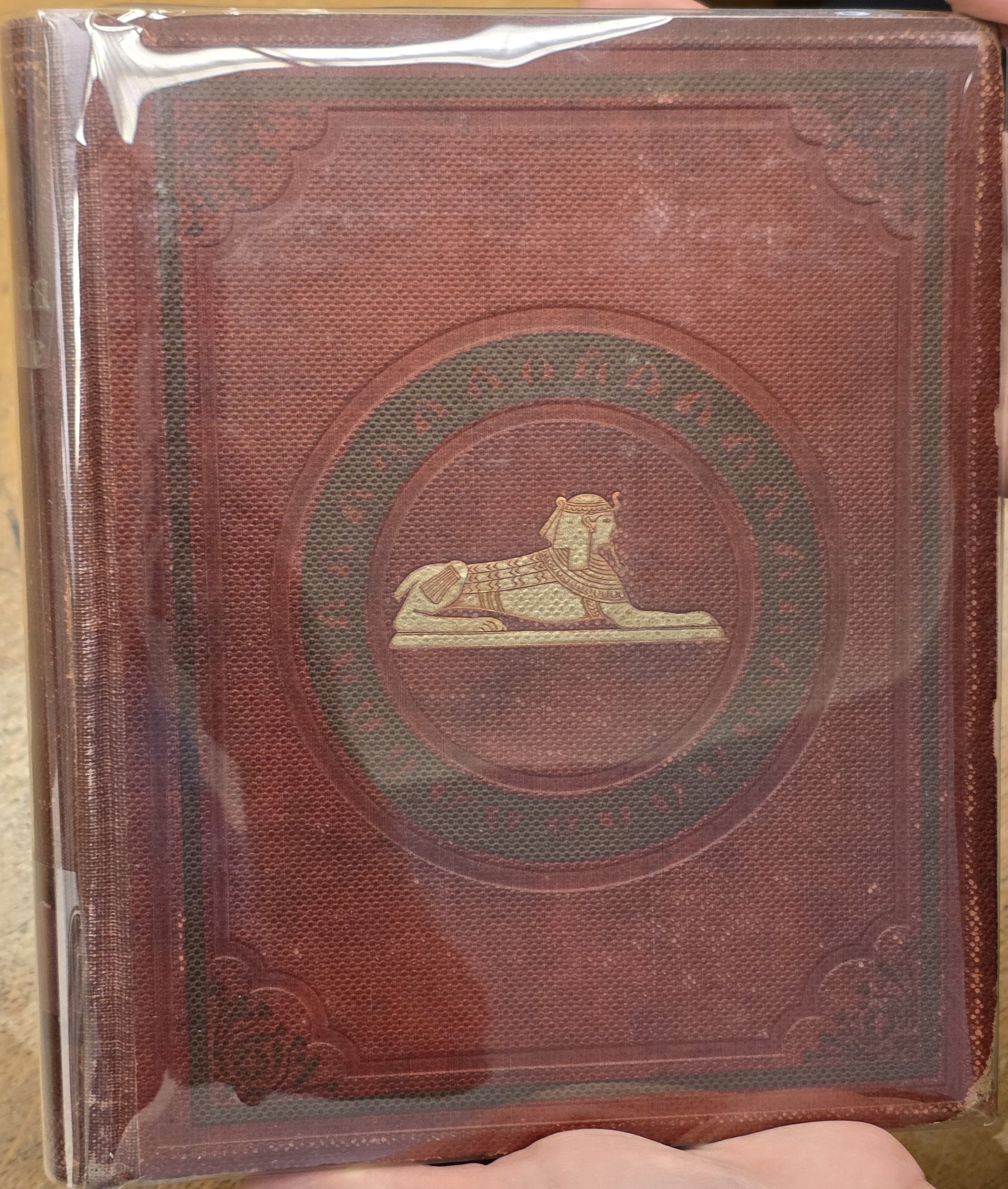
Binding Description
Original red publisher’s cloth with a gilt sphinx; the band around the roundel, the borders, and the corner ornaments are stamped in green. Housed in a protective jacket.
Presentation / Association
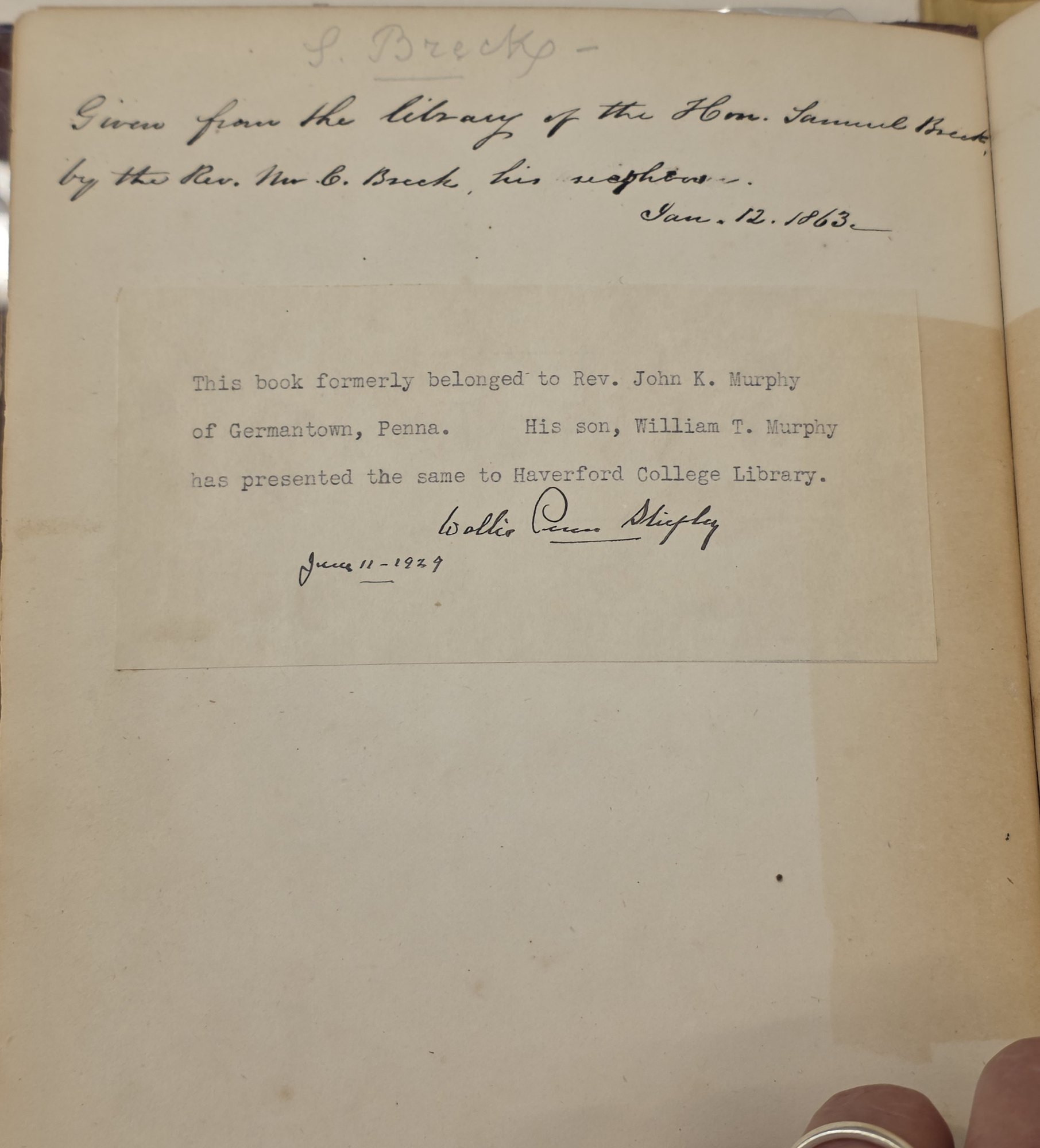
Pencil: “S. Breck”
“Given from the library of the Hon. Samuel Breck, by the Rev. Wm. C. Breck, his nephew. Jan. 12. 1863.”
Typed slip: “This book formerly belonged to Rev. John K. Murphy of Germantown, Penna. His son, William T. Murphy has presented the same to Haverford College Library.” Signed “Walter Penn Shipley” and dated “June 11-1929.”
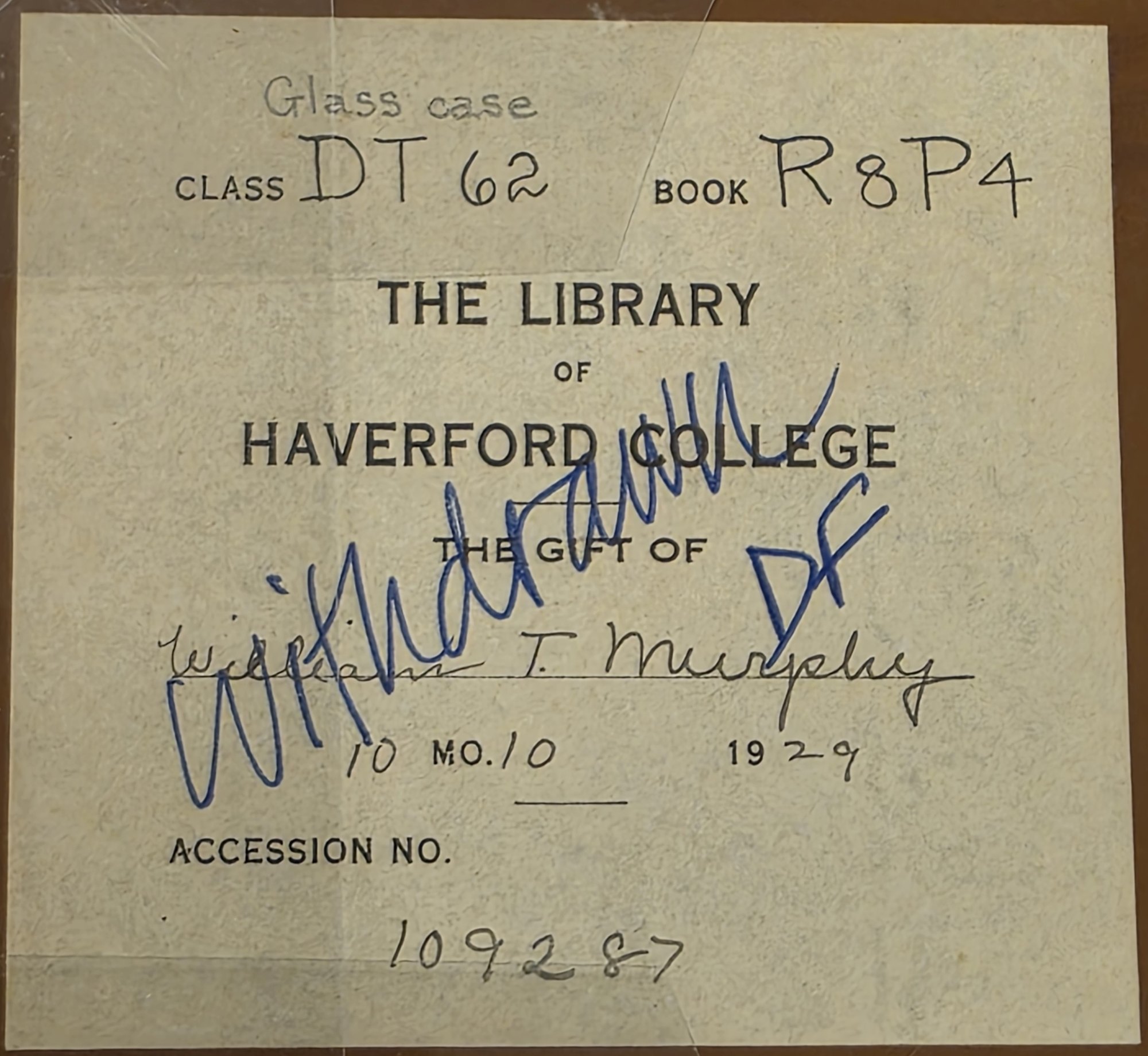
Bookplate: “Glass case · Class DT 62 · Book R8P4 · The Library of Haverford College · The gift of William T. Murphy · 10 mo. 10 1929 · Accession no. 109287,” stamped “Withdrawn DF.”
Provenance Chain
Hon. Samuel Breck (1771–1862), Philadelphia → Rev. Wm. C. Breck, his nephew — gift, January 12, 1863 → Rev. John K. Murphy (1827–1900), Germantown → William T. Murphy — gift to Haverford College Library, 1929 → Withdrawn from Haverford College → Brooklyn Museum Libraries & Archives — purchase
Provenance Narrative
The Rev. Wm. C. Breck gave the book from the library of his uncle, the Hon. Samuel Breck (1771–1862), on January 12, 1863. It later belonged to the Rev. John K. Murphy of Germantown; his son William T. Murphy gave it to Haverford College in 1929. Haverford withdrew it, and Brooklyn later purchased it.
Copy Notes
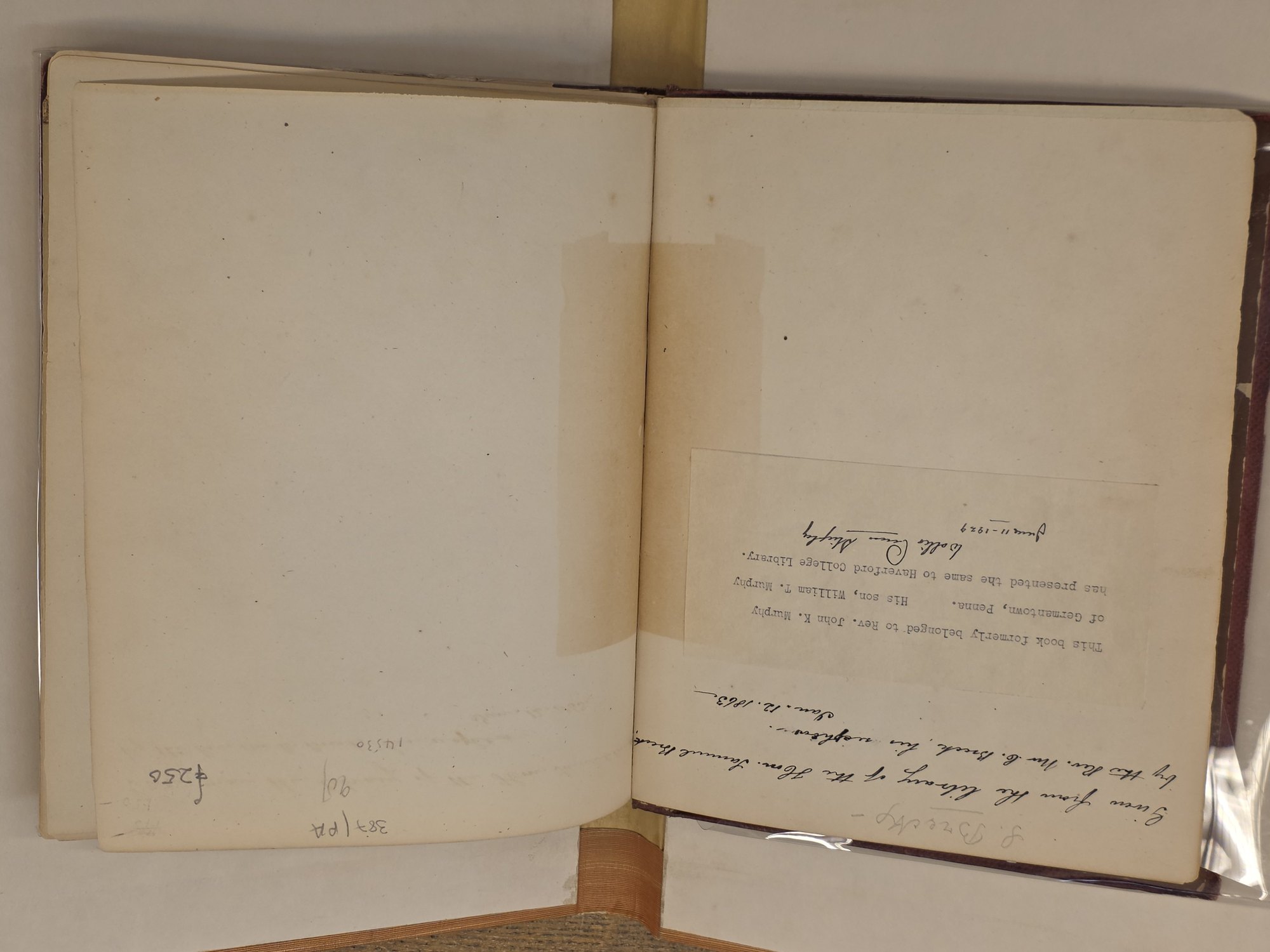
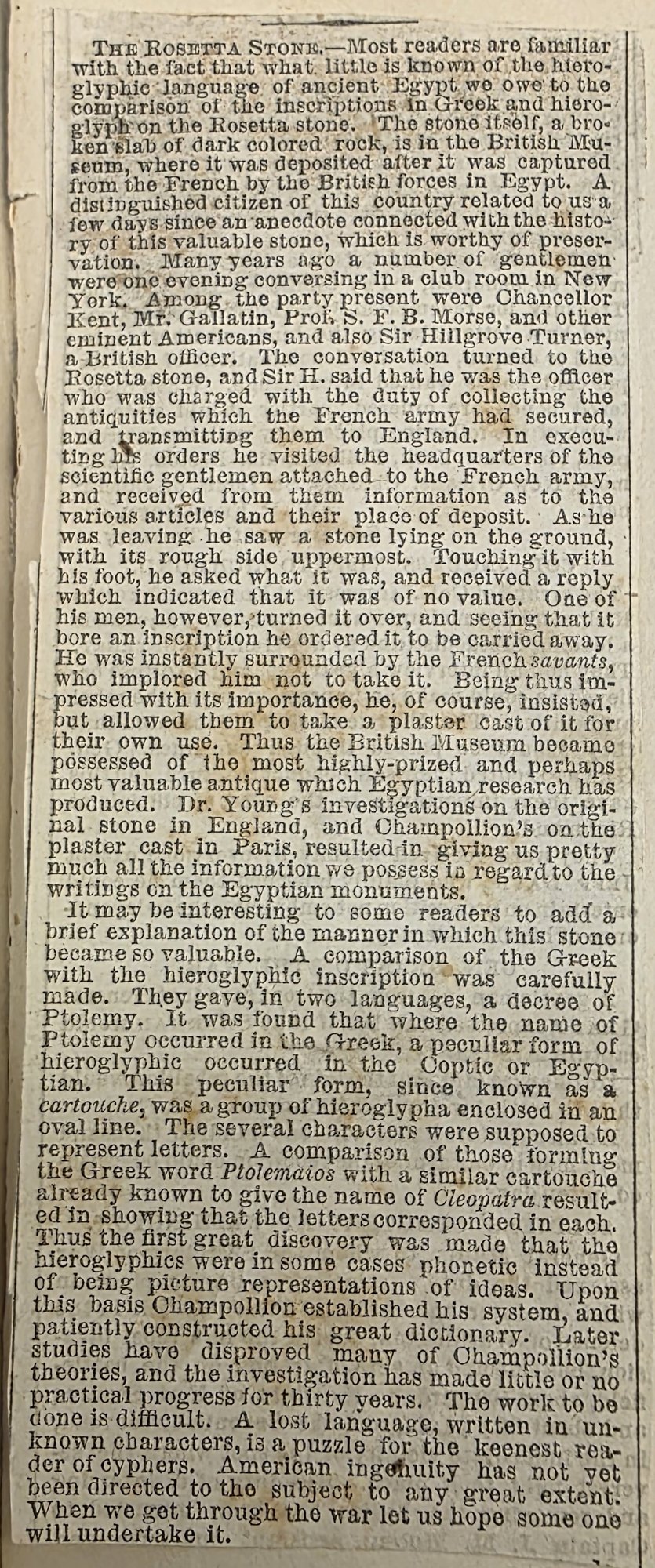
A mounted clipping, dated by the Brooklyn catalog to 1864, ends: “When we get through the war let us hope some one will undertake it.” Its newspaper is unidentified. A pencilled date on the junior-members list is emended from 1849 to 1859. Later pencil on the facing leaf: “387/PA,” “90,” “14510,” “$250.”
Newspaper Clipping
The Rosetta Stone.—Most readers are familiar with the fact that what little is known of the hieroglyphic language of ancient Egypt we owe to the comparison of the inscriptions in Greek and hieroglyph on the Rosetta stone. The stone itself, a broken slab of dark colored rock, is in the British Museum, where it was deposited after it was captured from the French by the British forces in Egypt. A distinguished citizen of this country related to us a few days since an anecdote connected with the history of this valuable stone, which is worthy of preservation. Many years ago a number of gentlemen were one evening conversing in a club room in New York. Among the party present were Chancellor Kent, Mr. Gallatin, Prof. S. F. B. Morse, and other eminent Americans, and also Sir Hillgrove Turner, a British officer. The conversation turned to the Rosetta stone, and Sir H. said that he was the officer who was charged with the duty of collecting the antiquities which the French army had secured, and transmitting them to England. In executing his orders he visited the headquarters of the scientific gentlemen attached to the French army, and received from them information as to the various articles and their place of deposit. As he was leaving he saw a stone lying on the ground, with its rough side uppermost. Touching it with his foot, he asked what it was, and received a reply which indicated that it was of no value. One of his men, however, turned it over, and seeing that it bore an inscription he ordered it to be carried away. He was instantly surrounded by the French savants, who implored him not to take it. Being thus impressed with its importance, he, of course, insisted, but allowed them to take a plaster cast of it for their own use. Thus the British Museum became possessed of the most highly-prized and perhaps most valuable antique which Egyptian research has produced. Dr. Young’s investigations on the original stone in England, and Champollion’s on the plaster cast in Paris, resulted in giving us pretty much all the information we possess in regard to the writings on the Egyptian monuments. It may be interesting to some readers to add a brief explanation of the manner in which this stone became so valuable. … Later studies have disproved many of Champollion’s theories, and the investigation has made little or no practical progress for thirty years. The work to be done is difficult. A lost language, written in unknown characters, is a puzzle for the keenest reader of cyphers. American ingenuity has not yet been directed to the subject to any great extent. When we get through the war let us hope some one will undertake it.
People in This Copy
Samuel Breck · Rev. Wm. C. Breck · Rev. John K. Murphy · William T. Murphy · Walter Penn Shipley
Sources and Documentation
Five copy photographs, October 2026; Brooklyn catalog record. Catalog record ↗
Visual Record
Images: copy photographs, Brooklyn Museum Libraries & Archives, October 2026.